Weekly Summary
The week opened with a powerful risk-on impulse as Trump called off planned strikes against Iran and floated a Strait of Hormuz deal within 24 hours, draining the geopolitical premium out of crude and unleashing a mega-cap tech rally that pushed the S&P 500 above 7,600 on Monday. Momentum extended into Tuesday, when a historic Palantir print sent the index above 7,700 for the first time and lit up the entire AI infrastructure and semiconductor complex. Hormuz remained the dominant theme all week, whipsawing crude between deal optimism and escalation fear and dragging energy, rates, and risk appetite along with it. The middle of the week turned choppier as diplomacy stalled, hawkish Fed commentary from Kashkari and Schmid rattled rates, and a sharp mean-reversion in chips and software offset an otherwise strong earnings cycle. Oil spiked again Thursday on an Iran-Oman transit framework, but a weak July payrolls report Friday reset the tightening narrative, knocked hike odds lower, and drove rotation into growth and cyclicals to close the week higher despite the noise.
WTI Crude Oil ETF (USO) was the week's dominant mover, down 8.7% as the collapse in the Iran risk premium overwhelmed intermittent supply scares. Gold (GLD) ran the other way, up 7.2% on safe-haven demand and falling rate-hike odds, while the Nasdaq 100 ETF (QQQ) added 5.1% on the AI-led tech rally. Japan (EWJ, chart below) gained 4.9% on the joint US-Japan yen intervention, and the S&P 500 rose 3.6%.
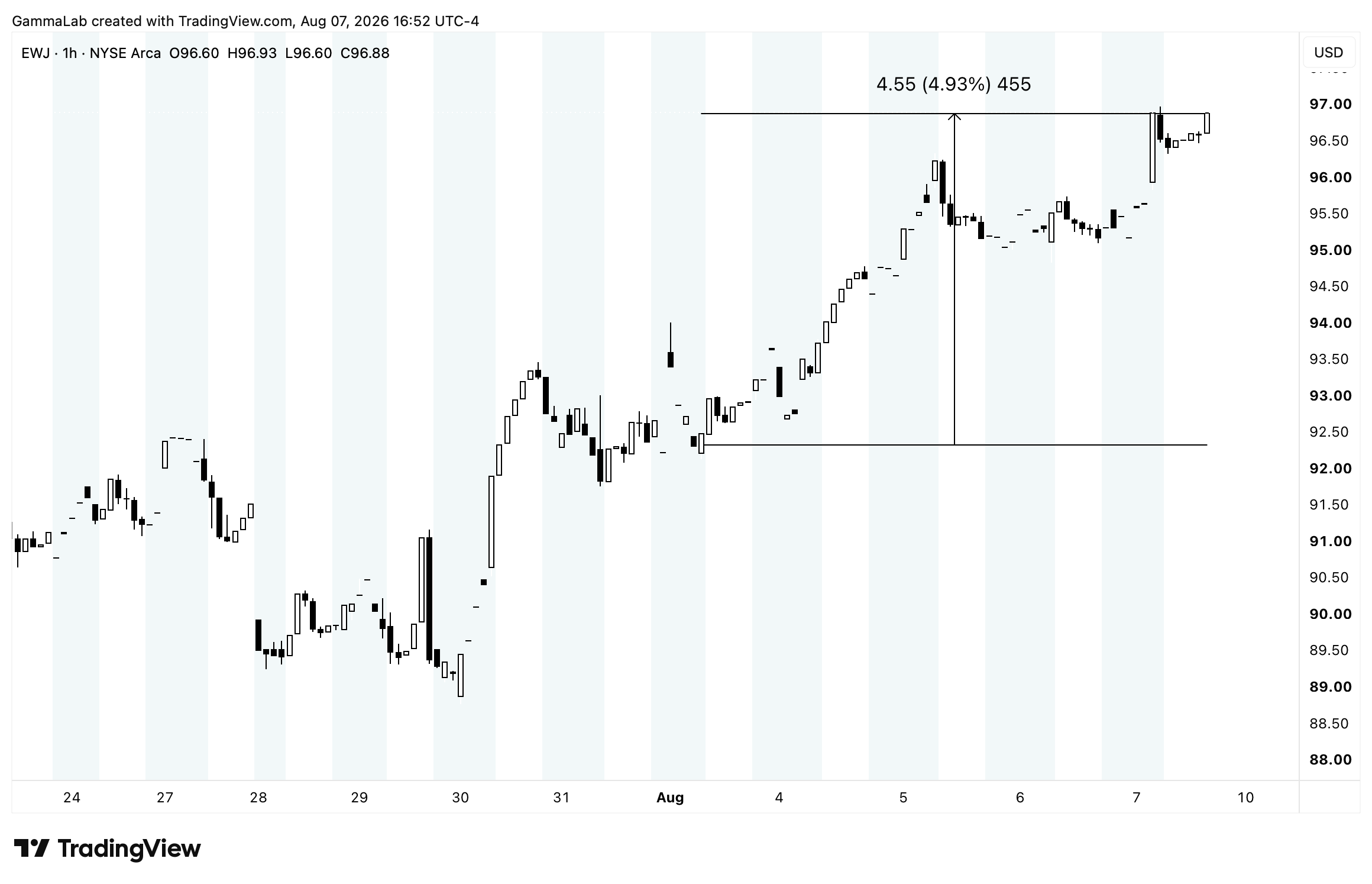
The data flow was mixed and secondary to Hormuz for most of the week, but Friday's July Employment Situation Report proved decisive: nonfarm payrolls fell 23,000 against an 86,000 consensus, private payrolls grew only 30,000, and average hourly earnings rose just 0.1%, pulling September hike odds down toward 40% and driving the rotation into rate-sensitive names. Earnings were a heavy factor throughout, with beats and misses driving outsized single-stock moves in tech and industrials.
Monday
The S&P 500 rose 1.5% to close above 7,600 for the first time since early June as Trump called off strikes against Iran and signaled a Hormuz deal could land within 24 hours, draining crude's risk premium. WTI Crude Oil ETF (USO) led the tape, down 5.5%, redirecting capital into mega-cap tech. Communication services led with a 4.3% gain as Meta surged 6% and Alphabet rose more than 4%, while energy fell 1.5% after Trump publicly pressured oil companies on gasoline prices. On the diplomatic front, Iran's Foreign Ministry flatly denied any direct talks with Washington, warning of danger to US warships if the blockade stayed in place. In company news, Palantir beat Q2 EPS by $0.07 ahead of the close, AstraZeneca was reported in merger talks with Bristol-Myers Squibb, and the joint US-Japan yen intervention continued to reverberate with USDJPY down 4.4% since the prior Wednesday.
Tuesday
The S&P 500 surged 1.8% to close above 7,700 for the first time, driven by a historic Palantir beat that ignited AI infrastructure, semiconductors, and software. WTI Crude Oil ETF (USO) again led the movers, down 5.2%, as Bessent said a Hormuz agreement could arrive as soon as Tuesday or Wednesday. Palantir jumped 29.4% after Q2 US commercial revenue rose 149% year-over-year and full-year guidance was lifted to $8.16 billion, sending the iShares Semiconductor ETF up 6.6% with Intel, AMD, Broadcom, and Lam Research all sharply higher. Caterpillar delivered the largest industrial beat of the session, topping EPS by $1.95, while Wayfair jumped nearly 30% and Zebra Technologies surged 26.5%. The June JOLTS reading came in at 7.359 million, below the prior revised print, and Treasuries rallied alongside the geopolitical optimism.
Wednesday
The S&P 500 slipped 0.2%, pausing a four-session rally as Hormuz diplomacy stalled and a sharp semiconductor selloff offset a sweeping earnings beat cycle. Gold ETF (GLD) led the movers, up 4.1%, surging to $4,196 an ounce in one of its largest single-day fair-value outperformances in a decade as hawkish Fed commentary hit risk. Kashkari said it is time to begin slowly raising rates and Schmid warned inflation extends beyond energy, sending the VIX up nearly 13% above 18. Semiconductors were the epicenter of selling, with AMD down 7.8% on an in-line guide and SpaceX sinking roughly 12% on $18.4 billion in quarterly capex, while Alphabet dropped more than 5% on Jeff Dean's departure and Demis Hassabis stepping back at DeepMind. On the upside, Shopify surged roughly 20% on a large beat and raised guidance, Eli Lilly rose 4.6% on a Mounjaro-driven quarter, and Arista added nearly 10%.
Thursday
The S&P 500 slipped 0.2% as a sharp intraday oil surge overwhelmed early tech gains and a solid earnings day. WTI Crude Oil ETF (USO) led the movers, up 3.5%, after Iran and Oman agreed to a transit framework imposing service-based fees and, under a draft bill, banning US and Israeli vessels, pushing Brent above $82. Software was the hardest-hit area, with AppLovin collapsing roughly 18% on a revenue miss and cascading into Salesforce, ServiceNow, Oracle, and Adobe, while Datadog fell nearly 18% and Honeywell Aerospace plunged around 20% on a cut organic sales outlook. Defense and energy led the winners, with CACI International up nearly 23% and Parker-Hannifin gaining over 6% on a strong beat and raised guidance. July ADP employment came in at just 44,000, well below the 75,000 consensus, and initial jobless claims printed at 199,000.
Friday
The S&P 500 gained 0.6% as a sharply weaker July jobs report pulled hike odds lower and drove rotation into growth, cyclicals, and rate-sensitive sectors. Gold ETF (GLD) led the movers, up 2.3%, as spot gold climbed nearly 3% to $4,365 with Newmont up 7.2% and the miners ETF adding 7.1%. Nonfarm payrolls fell 23,000 against an 86,000 consensus, average hourly earnings rose just 0.1%, and two-year yields dropped more than 7 basis points to 4.17% as September hike odds fell toward 40%. Consumer discretionary led at 1.5%, with Airbnb surging 17.4% and Uber up 6.5% on strong earnings, while technology gained 1.4% on semiconductor and software strength. Energy lagged, down 1.1%, and The Trade Desk collapsed nearly 27% after a revenue miss and weak Q3 guidance drew a wave of downgrades.
Gamma Situation
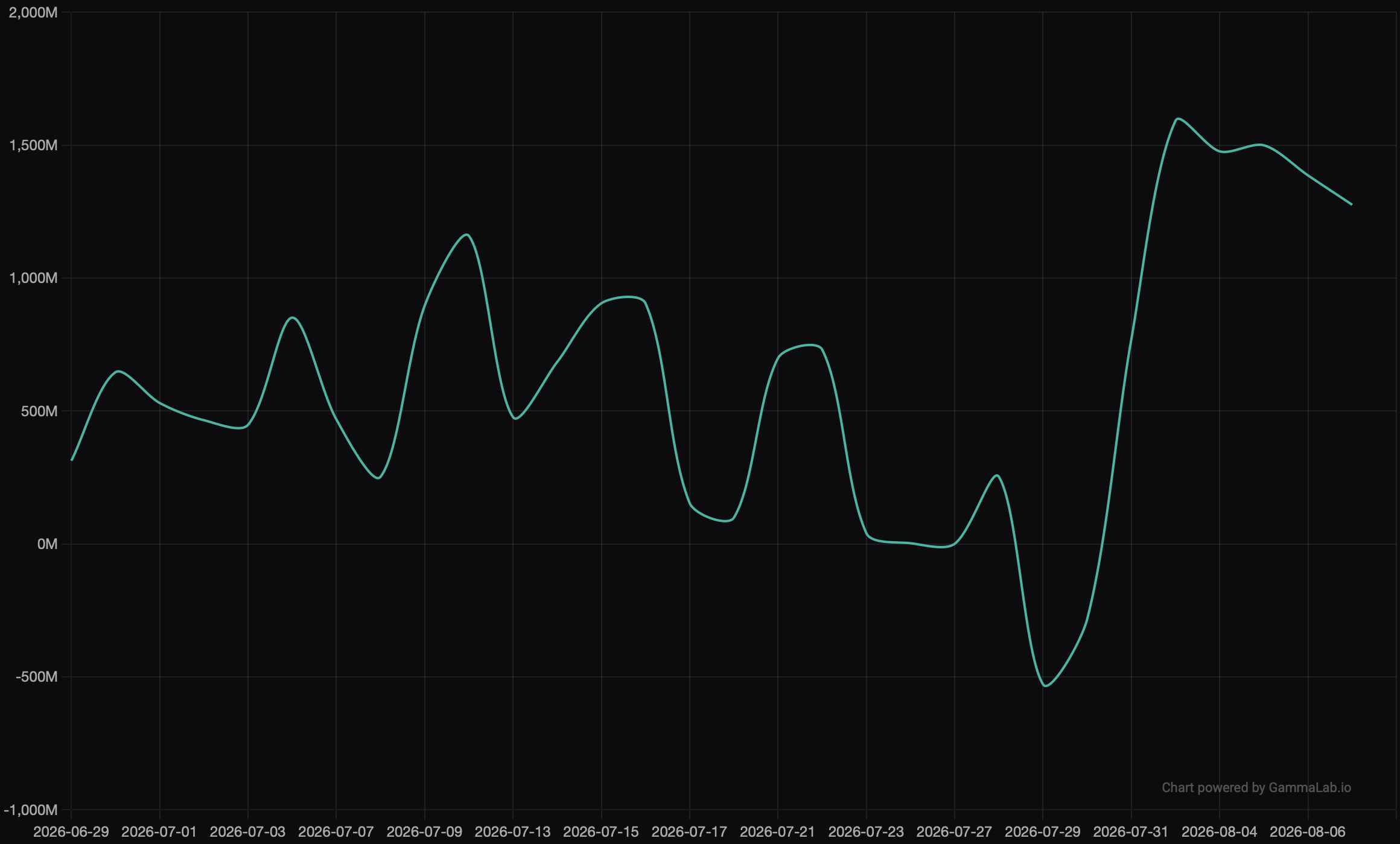
SPX gamma exposure closed the week at $1276 mln, down from $1592 mln at the start of the week, a decline of -$316 mln in dealer gamma even as spot pushed higher. The gamma flip level rose to 7521 from 7455, a 66-point climb that tracked the spot move up to a 7776 close. With spot sitting comfortably above the flip, dealers remain long gamma into next week, pointing to a market that should stay comparatively pinned despite the reduction in the overall gamma imbalance (chart below).
Systematic Situation
CTA equity exposure rose $3B over the week to $63B, from $61B, as trend signals firmed modestly on the rally. That shift wasn't material enough to chart this week.
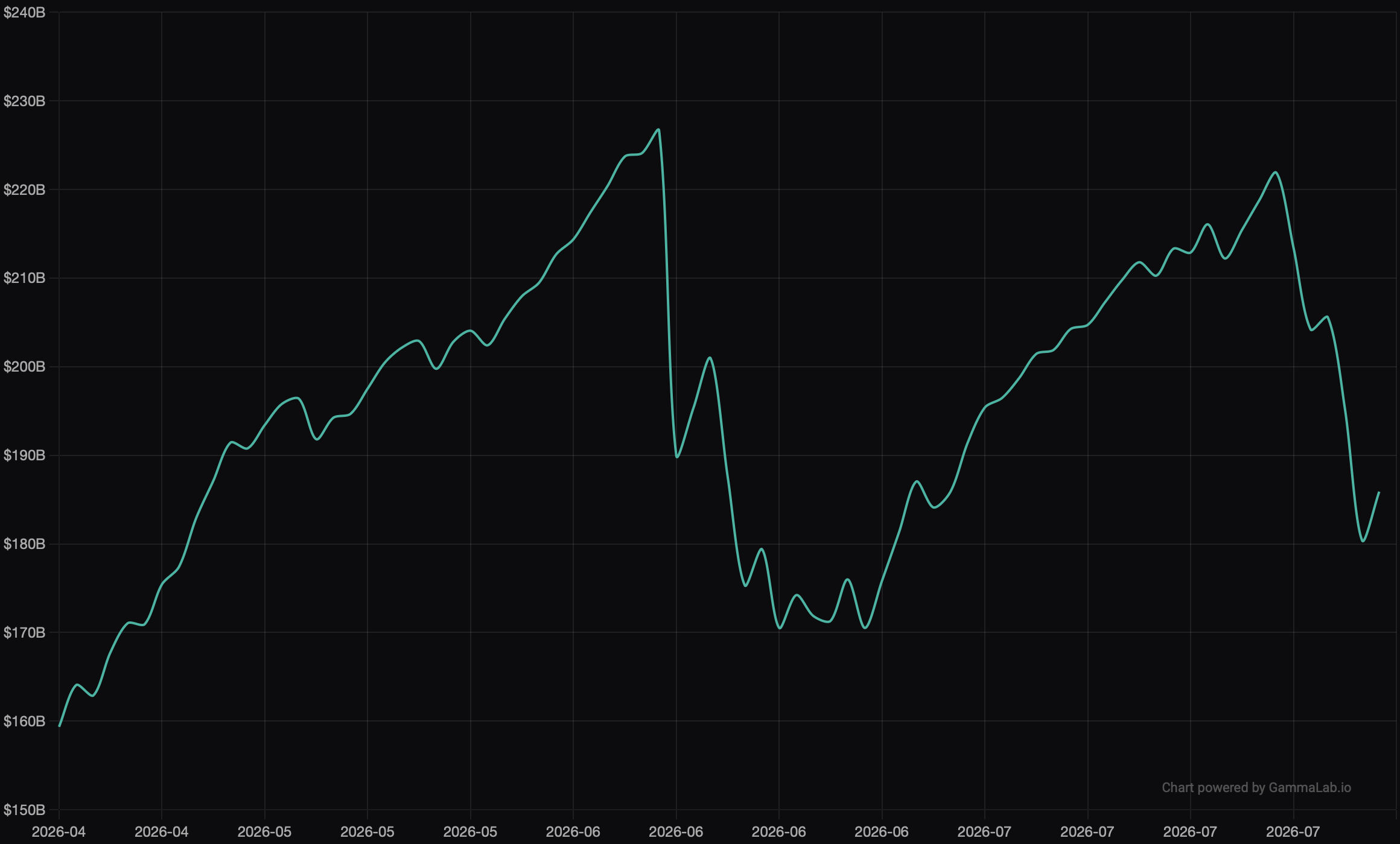
Vol-control notional exposure fell $18B over the week, moving from $204B to $186B, a large enough swing to clear this week's materiality bar as realized vol picked up through the midweek chop (chart below).
Notable Earning Reports
- SpaceX (SPCX) - Aug 4, 2026 | EPS -$0.09 vs -$0.23 est | Rev $7.81B vs $6.83B est
- Eli Lilly (LLY) - Aug 5, 2026 | EPS $8.38, no est | Rev $22.97B, no est
- Advanced Micro Devices (AMD) - Aug 4, 2026 | EPS $1.66 vs $1.62 est | Rev $11.54B vs $11.31B est
- Caterpillar (CAT) - Aug 4, 2026 | EPS $8.17 vs $6.22 est | Rev $20.50B vs $19.34B est
- HSBC Holdings (HSBC) - Aug 4, 2026 | EPS not reported | Rev $19.10B vs $18.70B est
- Merck (MRK) - Aug 4, 2026 | EPS -$0.13 vs -$0.27 est | Rev $16.61B vs $16.37B est
- Palantir Technologies (PLTR) - Aug 3, 2026 | EPS $0.41 vs $0.34 est | Rev $1.94B vs $1.81B est
- Arista Networks (ANET) - Aug 4, 2026 | EPS $1.02 vs $0.89 est | Rev $3.04B vs $2.83B est
- Toyota Motor (TM) - Aug 4, 2026 | EPS $120.69 vs $75.30 est | Rev $127.70B vs $122.00B est
- Sandisk (SNDK) - Aug 5, 2026 | EPS $39.25 vs $34.96 est | Rev $8.96B vs $8.48B est
Earnings Outlook for next week:
- Applied Materials Inc (AMAT) - Aug 13, 2026 | EPS est $3.46 | Rev est $9.17B
- Cisco Systems (CSCO) - Aug 11, 2026 | EPS est $1.19 | Rev est $17.16B
- Cisco Systems (CSCO) - Aug 12, 2026 | EPS est $1.19 | Rev est $17.16B
- Palantir Technologies (PLTR) - Aug 10, 2026 | EPS est $0.35 | Rev est $1.84B
- The Walt Disney Company (DIS) - Aug 12, 2026 | EPS est $1.88 | Rev est $25.67B
- Brookfield Corporation (BN) - Aug 13, 2026 | EPS est $0.67 | Rev est $1.72B
- Williams Companies (WMB) - Aug 10, 2026 | EPS est $0.51 | Rev est $2.83B
- NetEase (NTES) - Aug 12, 2026 | EPS est $15.51 | Rev est $29.99B
- NetEase (NTES) - Aug 13, 2026 | EPS est $15.51 | Rev est $29.99B
- Emerson Electric (EMR) - Aug 11, 2026 | EPS est $4.85B...
This is a post from GammaLab — real-time market intelligence powered by AI. Log in or subscribe to access the full platform.